
Research
Vāc-Jiàn, Part 1: Your meaning comes first
How YNOVA’s multilingual AI turns what a learner means into English practice, with specialist assessment and a clear next attempt.
Tamil Selvan · 20 October 2026 · 9 min read
Tamil Selvan · 20 October 2026 · 13 min read · Updated

Vāc-Jiàn combines five components to assess English and choose the next teaching move. Pronunciation, grammar, clarity and word-choice evidence inform a teaching controller. This article explains the architecture, YNOVA’s six-system comparison and the processing-time measurements behind NOVA’s multilingual English tutoring.
A learner says something in English, reaches for a phrase in another language, and pauses. Before an AI tutor corrects the sentence, it has several questions to settle. Did it hear the English accurately? Does it understand the learner’s intention? Would a correction help now, or would it interrupt the point the learner is trying to make?
Vāc-Jiàn separates these questions. Its five components combine trained models with explicit checks for pronunciation and rhythm, grammar, clarity, word choice, and the next teaching move. Each component supplies evidence for its own judgment. The teaching controller decides which evidence matters for this turn and turns it into a reply the learner can act on.
That separation matters to everyone using the system. A learner needs a useful next attempt. A teacher needs to distinguish a recurring difficulty from an unreliable recording. A school integrating the API needs to understand a decision before allowing it to affect a learner’s practice.
The speech component uses WavLM-Large with a trained sound classifier. It compares the expected English sounds with evidence in the recording, using the established goodness-of-pronunciation approach. Pitch and timing are measured separately, so evidence about an individual sound stays distinct from evidence about the rhythm of a sentence.
Only English stretches are in scope for English pronunciation assessment. The component leaves a safety margin around language switches, where a mistaken boundary could turn another language into an apparent English error. If the recording is too noisy, too short, or cannot be aligned reliably with the expected sounds, it returns a reason for withholding a score.
This is an important assessment choice. Research on speech language models has found that apparently good overall scores can coexist with weak identification of individual pronunciation errors. A learner needs feedback on the sound they can practise, and a teacher needs to know when the recording cannot support that feedback. Parikh and colleagues’ study of L2 speech evaluation examines that distinction.
The grammar component uses DeBERTa-v3-large to flag English words that may need an edit. It preserves their positions in the original turn. Other-language stretches are excluded from its English error signal, so a Japanese phrase inside a sentence does not become a grammar fault.
A flag is a candidate for teaching. The controller can hold it back while the learner resolves a more important problem, such as an unclear request. This also allows a teacher or partner to examine a proposed correction independently of the tutor’s wording. The emphasis on restrained correction follows a practical concern documented in research on language models for grammatical error correction: a fluent rewrite can change language that did not need changing.
The clarity component uses ModernBERT-large to examine the organisation of a message. It considers connections between ideas and the position of the main request or conclusion. A borrowed word does not, by itself, make a message incoherent.
The task and audience matter here. A direct request can suit one situation; an explanation before the request can suit another. The component can withhold a structural judgment when the turn is too short to support one or when the task falls outside its scoring scope. It does not need to invent a clarity score for “Yes, tomorrow.”
Word-choice assessment combines known word patterns with statistics from licensed English text and a CEFR-J vocabulary profile. The purpose is to identify a phrase worth examining, such as “open the light,” without pushing a learner towards unnecessarily advanced vocabulary.
An unusual phrase can also express an unfamiliar intention. Before suggesting “turn on the light,” the tutor needs enough context to establish that switching on a light is the intended action. For a rare phrase, the reference text may offer too little evidence to support a correction. Nationality cannot establish the learner’s intended meaning.
The trained controller combines the diagnostic evidence with explicit teaching rules. Its training uses teacher-written or teacher-approved replies, followed by preference training on alternative teaching responses. It chooses the kind of help before the reply is worded: clarification, a cue, a partial frame, or a worked example.
The controller keeps the learner’s intended meaning central. It can postpone a grammar correction while asking about an ambiguous phrase, then return to the language once the learner has clarified the task. The API exposes this decision separately from the final reply, giving partners a way to inspect the teaching action.
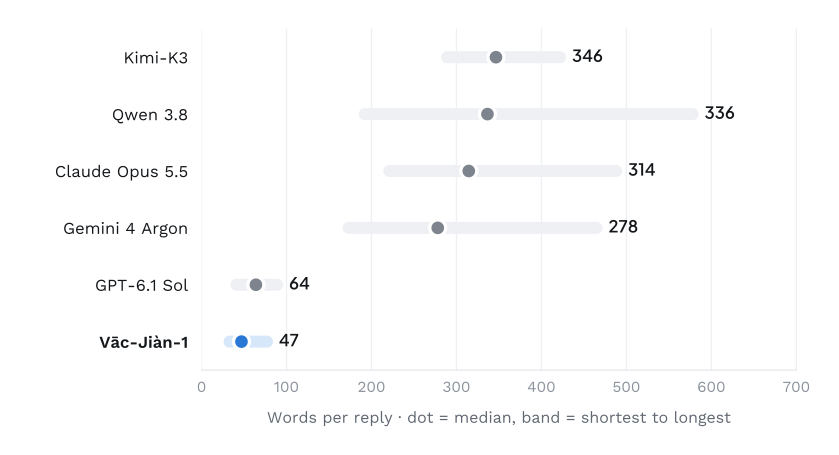
Eight mixed-language cases, with three replies per system, produced 144 replies. The comparison covers GPT-6.1 Sol, Claude Opus 5.5, Gemini 4 Argon, Kimi-K3, Qwen 3.8 and Vāc-Jiàn-1. The same five checks were applied to each system’s replies.
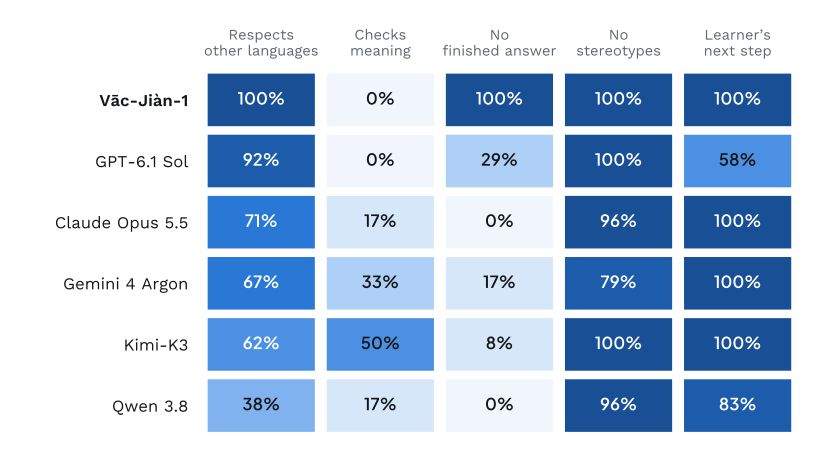
| System | All applicable checks | Respects other languages | Checks meaning | Leaves answer to learner | Median words |
|---|---|---|---|---|---|
| Vāc-Jiàn-1 | 96/102 (94%) | 24/24 | 0/6 | 24/24 | 47 |
| GPT-6.1 Sol | 67/102 (66%) | 22/24 | 0/6 | 7/24 | 64 |
| Claude Opus 5.5 | 65/102 (64%) | 17/24 | 1/6 | 0/24 | 314 |
| Gemini 4 Argon | 65/102 (64%) | 16/24 | 2/6 | 4/24 | 278 |
| Kimi-K3 | 68/102 (67%) | 15/24 | 3/6 | 2/24 | 346 |
| Qwen 3.8 | 53/102 (52%) | 9/24 | 1/6 | 0/24 | 336 |
Vāc-Jiàn-1’s 94% result is 96 passes out of 102 applicable checklist judgments. Four checks contribute 24 judgments each; the ambiguity check contributes six. A reply passes that check if it asks which meaning the learner intends or explicitly offers both readings before giving English advice.
The largest practical difference is in finished answers. Vāc-Jiàn-1 leaves the response for the learner in 24 of 24 replies; the five general systems do so in 13 of 120. On clarification, Vāc-Jiàn-1 misses all six applicable replies. Keeping these outcomes separate prevents the aggregate from concealing a teaching failure.
Download the evaluation tables and chart values for the checklist counts, response timings and language-mix comparison.
Consider the phrase “konjam kashtam” in a message to a manager about a Friday deadline. It can indicate difficulty or soften a refusal. In this example, the tutor asks whether the learner can complete the work with effort or needs to decline. Those intentions call for different English.
After the learner clarifies, a partial frame may be enough: “I’m concerned this might…” The learner supplies the deadline problem and proposes an alternative. The next turn gives the tutor evidence about the learner’s understanding and ability to express the message.
Sometimes a partial frame is too little. A learner may need a complete example before attempting an unfamiliar task. The useful next step is then to explain a choice in the example, adapt it to another situation, or try again with less support. We judge the help by the learner’s subsequent attempt; withholding a full sentence is not a teaching achievement on its own.
Research on AI tutoring reinforces the need to examine performance after assistance is removed. Bastani and colleagues’ study concerns high-school mathematics, so it does not establish an effect for English learning. It does provide a reason to distinguish successful assisted practice from later independent performance. For Vāc-Jiàn, a new situation with a different deadline or audience provides a more demanding check than repeating the same sentence.
A teacher needs more than a score that rises from one week to the next. Improvement is easier to interpret when the report distinguishes the learner’s initial attempt, the help offered, and the response after that help. A successful retry after a worked example means something different from a successful first attempt on a new task.
These distinctions also focus classroom attention. A repeated difficulty expressing a polite refusal can become a lesson activity. A poor recording needs another attempt at recording. An uncertain interpretation needs the learner’s explanation. Combining all three into a low score would leave the teacher to reconstruct the problem.
First-language support belongs in that account. During supported practice, a learner can use another language to establish meaning and work towards English. In timed exam sections, NOVA switches first-language support off so learners practise under the task’s stated conditions. Supported practice lets them establish meaning in another language before working towards English.
The underlying teaching choices remain inspectable across models. A capable general model can follow a careful tutoring prompt. Vāc-Jiàn’s value depends on making the assessment evidence and teaching decision consistent enough to examine across many turns, including cases where the system cannot judge reliably.
The diagnostic components can run in parallel because they answer independent questions about the same turn. The controller receives their evidence together instead of waiting for a chain of complete model responses. Smaller, specialised checks also give us more control over the computation spent on each assessment.
For a school, parallel processing helps keep feedback close to the learner’s attempt. Hosting also has to account for concurrent learners and the devices they use. We distinguish processing time from the complete pause experienced on a phone.
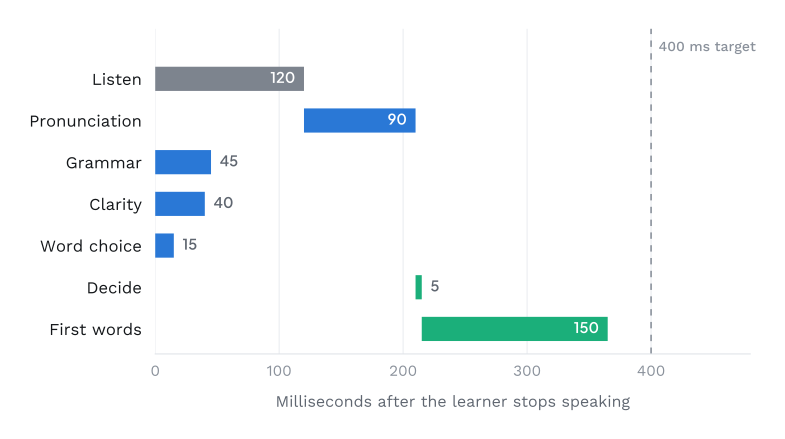
The five components fit within a 24–40 GB graphics-memory footprint. Parallel checks reduce the waiting between stages while keeping their individual results available to the controller. The reported processing timings describe this pipeline; the time a student experiences also depends on recording, the network and audio playback.
Clarification has a cost too. An unnecessary question can interrupt practice; a wrong assumption can teach the wrong message. The controller’s decision-cost analysis sets out that trade-off. With a cost of 2 for treating a refusal as difficulty, 5 for treating willingness as refusal and 0.5 for asking, clarification is the lower-cost choice when the probability of refusal is between 25% and 90%. Those are decision-policy values; changing the costs changes the threshold.
A model can follow a teaching rule without improving learning. Our evaluation therefore separates diagnostic accuracy, the appropriateness of the teaching move, and later unaided performance. An aggregate score cannot establish all three.
Diagnostic evaluation requires relevant human judgments and reporting by first language. It also requires the rate at which the system withholds a score. High accuracy obtained by declining nearly every difficult recording would have limited classroom value. Public resources such as Speechocean762 provide a pronunciation benchmark, while consented multilingual examples address language switches and learner intentions that a single public benchmark cannot cover.
Our data rules require a traceable source and permission for each example. Records retain the applicable rubric and processing history. Learners are separated across training and test sets, and examiner disagreement remains visible. School participation and permission to use a learner’s work for model training are separate decisions.
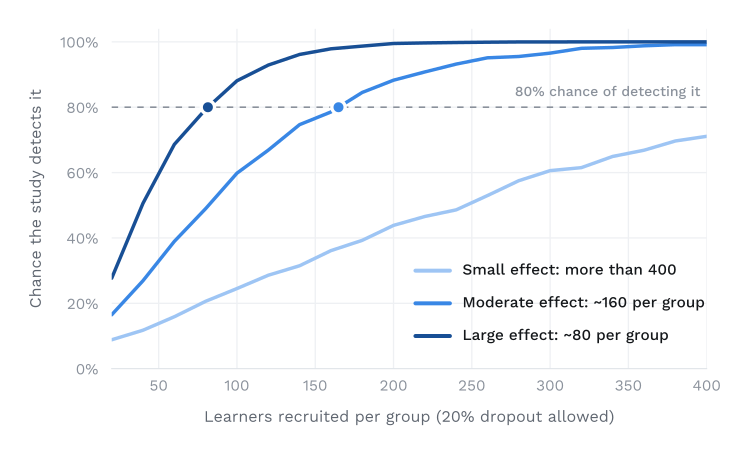
Learning evaluation asks whether learners can complete a later task without the tutor. Study-size analysis helps determine the number of participants needed for a chosen effect and expected dropout; it supplies no learning result by itself. A classroom pilot can reveal confusing feedback and excessive interruption, while a learning claim needs a study designed around that outcome.
The comparison that matters is useful English practice with appropriate alternatives. If a general-purpose tutor produces equal or better independent performance with less complexity, Vāc-Jiàn needs to justify its additional components. If performance differs by first language, the average cannot settle suitability for a particular class.
Vāc-Jiàn combines pronunciation and rhythm assessment, grammar assessment, clarity assessment, word-choice checks and a teaching controller. The components provide diagnostic evidence; the controller uses that evidence and the learning task to choose the next teaching move.
The comparison used eight mixed-language cases and three replies per case for each of six systems, producing 144 replies. Vāc-Jiàn-1 was compared with GPT-6.1 Sol, Claude Opus 5.5, Gemini 4 Argon, Kimi-K3 and Qwen 3.8 using a shared teaching checklist.
The 94% result is 96 passes across 102 applicable checklist judgments on 24 replies. Vāc-Jiàn-1 passed four criteria in all 24 replies, but scored 0 of 6 on checking ambiguous meaning. The percentage describes this evaluation, rather than diagnostic accuracy or learning gains.
YNOVA measured a median pipeline processing time of 372 ms across 20,000 turns, with a 95th percentile of 475 ms. The measurement concerns the processing pipeline. Recording, network transfer and playback add to the delay a learner experiences.
Part 2 reports the comparison counts, assessment boundaries and timing measurements. The linked evaluation-results.json file provides YNOVA’s published numerical summary. Schools and developers can contact YNOVA to discuss the component evidence, teaching decisions and requirements for their own learners.
Schools and training providers can bring this workflow into a term-long NOVA programme. The first conversation is about the learners’ goals and the practice a teacher wants to support. Participation arrangements need to specify teacher workload, learner access, and the evidence the school will receive. Data use and sharing choices belong in that agreement before a class joins.
Developers and edtech teams can discuss API access to the same component evidence and teaching decisions. Write to contact@ynova.ai with “Vāc-Jiàn” in the subject and tell us about your learners or the product you are building.
NOVA coaches IELTS Speaking in your own language, then steps back as you get stronger.
How YNOVA’s multilingual AI turns what a learner means into English practice, with specialist assessment and a clear next attempt.
Tamil Selvan · 20 October 2026 · 9 min read
How translanguaging shapes YNOVA's bilingual scaffolding: the learner's own language is a resource for building towards English, not the destination.
YNOVA learning design team · 26 September 2026 · 9 min read
