Tamil Selvan · 20 October 2026 · 9 min read · Updated
Vāc-Jiàn is YNOVA’s family of speech and language models for multilingual English learning. It combines specialist assessment with a teaching controller that helps learners turn an intended meaning into an English response. NOVA uses Vāc-Jiàn for IELTS and workplace English practice.
A learner wants to turn down a colleague’s proposal without damaging the relationship. They know the deadline will not work. Finding the English is harder.
Learner: “I think this proposal is… ちょっと難しい, maybe we reconsider.”
Tutor: “Are you saying the work is difficult but possible, or that you would like to decline the proposal?”
Learner: “I want to decline politely because the deadline will not work.”
Tutor: “You want to decline while keeping the discussion open. Try ‘I’m concerned this might…’ and name the deadline problem. Then ask about changing the scope.”
Learner: “I’m concerned this might put the deadline at risk. Could we reduce the scope?”
An example of the teaching exchange: clarify the intention, offer a starting point, then let the learner attempt the response.
The Japanese phrase ちょっと難しい can describe a difficulty or soften a refusal. A fluent translation can still send the wrong message. Asking the learner resolves the uncertainty; giving them half a sentence leaves them something useful to practise.
We built Vāc-Jiàn around that exchange. The assessment identifies what the learner needs; the teaching controller decides how much help to offer before the learner tries again.
Vāc means speech or voice in Sanskrit; jiàn means a mirror in Mandarin. Artwork animated with Google Veo from our Gemini illustration.
Practice begins with the learner’s meaning
Switching languages can tell a tutor something important. A learner may reach for a familiar phrase because its tone is closer to their intention, or because the English is missing. Vāc-Jiàn keeps those words available as evidence. Text marked as another language is excluded from English error assessment.
That protection matters in speech as well as writing. The pronunciation component assesses the English stretches of a recording. A Japanese phrase between two English clauses does not become a run of English pronunciation mistakes. If the recording cannot support an assessment, the component returns a reason instead of a score.
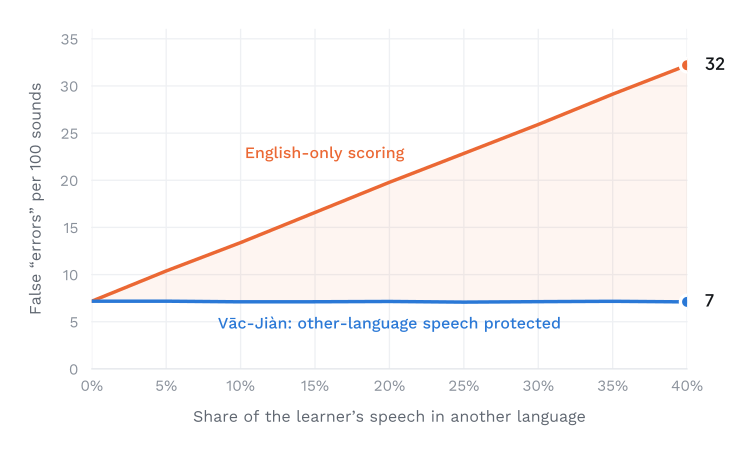
Feedback stays focused on English. YNOVA’s measured comparison uses 5,000 turns at each language-mix condition, with 60 sounds per turn. At a 20% share of other-language speech, false errors are 19.8 per 100 sounds with English-only scoring and 7.2 with language protection.
A language switch should not make a strong speaker appear less capable. At the 20% condition, protecting other-language speech reduced false errors by about 64%. The result concerns the stated language-mix conditions; it gives a teacher a reason to examine which stretches were assessed, alongside the score.
For the learner, the next step stays manageable. The tutor can ask a question, provide a partial frame or offer a worked example when one is appropriate. In the opening exchange, a grammar correction would be premature: “maybe we could reconsider” still leaves the colleague guessing about the deadline. The tutor first establishes that the learner intends to decline.
Once the meaning is clear, the learner can try the English. A later task can change the problem from a deadline to a budget, giving the teacher a way to check whether the learner can make a polite refusal without the same prompt. The aim is English they can use when the tutor is absent.
Specialist models, one teaching decision
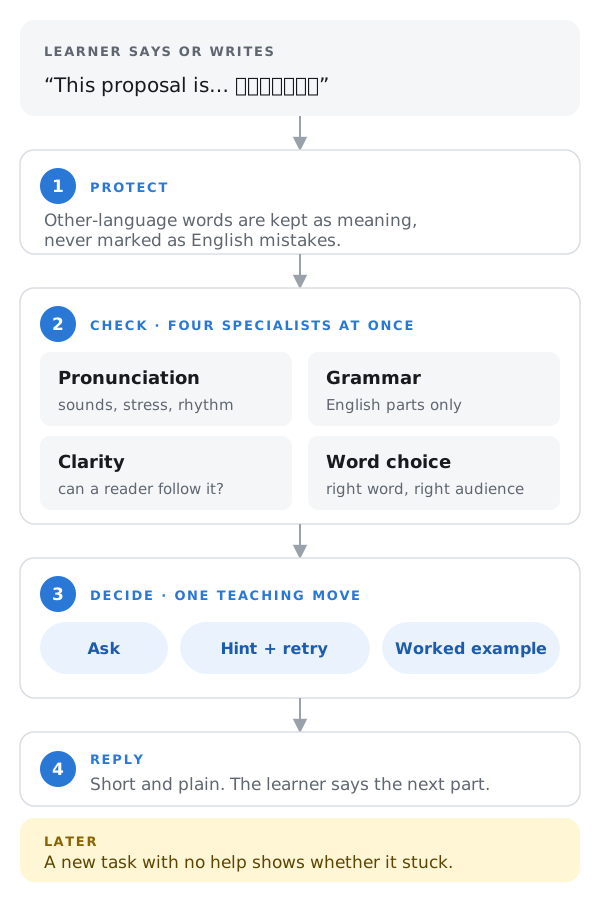
Vāc-Jiàn separates assessment from the decision to intervene. Four components examine the learner’s turn; the teaching controller uses their evidence to choose the help to offer. A possible grammar edit is therefore not automatically a correction the learner has to deal with immediately.
Four specialist assessments inform a single teaching move. Illustration generated with Gemini.
The pronunciation model examines English sounds, with pitch and timing measured separately. Grammar identifies words that may need an edit for the task. Clarity assesses the structure of the message, including the position of a request or conclusion. Word choice checks expressions against the intended meaning and audience.
The controller then decides which issue deserves attention now. It can hold a grammar point back while asking about an ambiguous phrase, or use a word from the learner’s other language as a bridge into English. The learner receives a short reply; the system retains the evidence and teaching decision separately.
Assessment produces evidence. The controller decides the next teaching move.
A general language model can explain grammar and produce excellent English. Vāc-Jiàn links that diagnosis to practice. Its controller chooses an intervention and leaves the learner with a response to produce. Separating those decisions also lets a teacher or partner examine the reason for the help a learner received.
Measured teaching behaviour
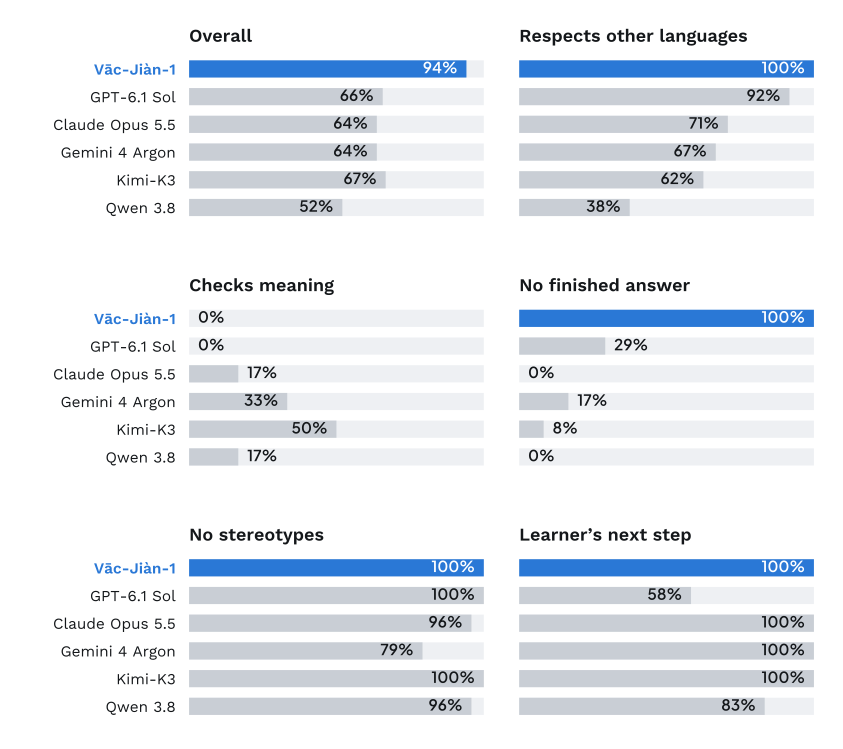
We compared Vāc-Jiàn-1 with GPT-6.1 Sol, Claude Opus 5.5, Gemini 4 Argon, Kimi-K3 and Qwen 3.8 on eight mixed-language cases. Each system produced three replies per case. A shared checklist assessed whether the reply respected the learner’s other language and left them with a useful next step.
Teaching choices, check by check. Vāc-Jiàn-1’s 24 replies passed 96 of 102 applicable checklist judgments. The full comparison contains 144 replies, with each check’s denominator reported separately.
Vāc-Jiàn-1 left the response for the learner to produce in all 24 replies. Across the five general systems, 13 of 120 replies met that criterion. This is a concrete difference in the practice those replies offer: the learner still has a task to complete.
A teacher can set the situation and the skill to practise, then use NOVA between lessons. A learner rehearsing a workplace refusal gets help with the intention as well as the phrasing. Someone preparing for IELTS can practise expressing an idea before attempting it under exam conditions. First-language support is switched off in timed exam sections.
For teachers, the useful record connects the learner’s attempt to the help offered and the next attempt. That context makes a progress summary more informative than a single score. Teacher reporting connects practice to progress; access to learner evidence follows the school’s sharing and consent arrangements.
School leaders also need a way to examine uneven performance across a multilingual class. Evaluation by first language makes those differences visible instead of letting an overall average conceal them. A result for one language group cannot establish accuracy for every other group.
Learner recordings and writing enter training only with opt-in consent. A school’s data is used for training only when its agreement permits it. Those decisions matter to the people practising, and to teachers choosing a service for their classes.
A specialised service for learning products
The same separation of evidence and teaching decisions gives developers a practical integration point. An English-learning product may need pronunciation evidence, grammar candidates or a recommendation to ask for clarification. It can use those outputs within its own learning activity rather than accept an undifferentiated chatbot reply.
The API exposes the diagnostic evidence alongside the teaching decision and learner-facing response. Partners can inspect the decision and apply their own teaching rules. An assessment that cannot be made is reported explicitly, including the absence of audio in a text-only request.
For partners and investors, NOVA brings the models into a recurring learning activity. Schools can use the practice workflow, while education developers can integrate component evidence through the API. The same assessment and teaching decisions support both routes. YNOVA’s work combines specialist training with an evaluation process that makes individual teaching choices visible as coverage grows.
Questions about Vāc-Jiàn
What is Vāc-Jiàn, and how does it teach English?
Vāc-Jiàn is YNOVA’s family of speech and language models for multilingual English learning. It combines specialist assessment with a teaching controller that chooses a clarification, hint or worked example, then gives the learner a next attempt to complete.
Can learners use their own language during English practice?
Learners can draw on another language to express an idea during supported practice. Vāc-Jiàn protects those stretches from English error assessment and helps the learner work towards an English response. First-language support is switched off in timed exam sections.
How are Vāc-Jiàn and the NOVA tutor connected?
Vāc-Jiàn supplies the assessment evidence and teaching decisions used by NOVA, YNOVA’s IELTS and workplace English tutor. NOVA provides the practice activity; Vāc-Jiàn assesses relevant parts of the learner’s attempt and helps determine the tutor’s next move.
How can teachers use Vāc-Jiàn with their classes?
Teachers can set the situation and skill to practise, then use NOVA between lessons. Reporting connects the learner’s attempt, the help offered and the next attempt. Teacher access to learner evidence follows the school’s sharing and consent arrangements.
What did YNOVA measure in the six-system comparison?
YNOVA evaluated 144 replies across six systems and eight mixed-language cases. Vāc-Jiàn-1 passed 96 of 102 applicable checklist judgments and left the response to the learner in all 24 replies. The checklist measures teaching behaviour; it does not measure later learning gains.